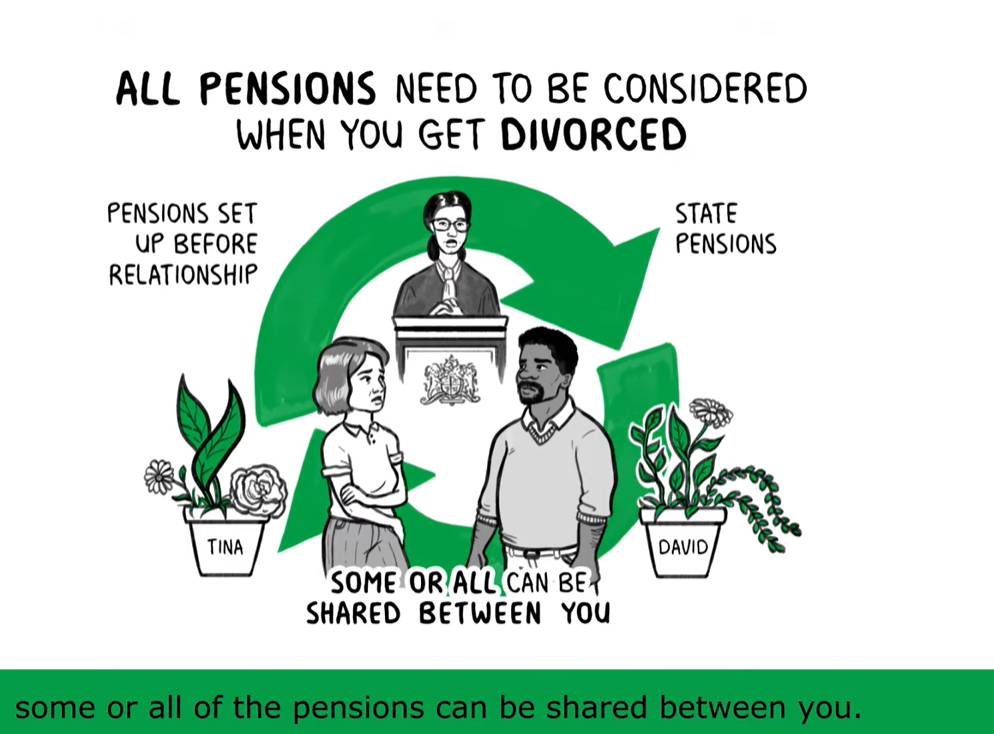
Pensions can be one of the more complicated parts of reaching a financial settlement on divorce. Different types of pensions work in different ways, and the figures provided by pension schemes cannot always be compared directly.
A pension sharing report enables the pensions held by both parties to be compared on a consistent basis and, where appropriate, calculates how they could be shared to achieve the outcome requested.
This guide explains the key parts of a pension sharing report, what the calculations are designed to show and what the figures mean, so you can approach the report with a clearer understanding of what you are looking at.
Types of pensions
Pensions come in two main types, which look and feel very different from each other:
Defined Benefit (DB) pensions give a promise of an income in retirement, where the amount of pension at a given retirement age is calculated by a set formula typically based on service and earnings. Pension increases are also spelled out, often by reference to inflation. With a DB pension, the income is known, but its comparable value is not.
Each DB pension scheme will provide its own valuation, the Cash Equivalent Transfer Value (CETV), but CETVs from different schemes are not necessarily calculated on the same basis. Two pensions promising the same retirement income can therefore have very different CETVs.
Defined Contribution (DC) pensions work the other way around. Its current value is known, because it is an investment account. What is not known is how much retirement income that account could provide.
The report looks at the pensions built up to the calculation date. Very rarely will it make allowance for pension benefits that may be built up in the future. Because DB and DC pensions work differently, the information we need for each pension is different.
Pension Sharing Report Part 1: Working out the gap between the parties’ pensions
Before we can compare the pensions fairly, we need to put them all on the same footing.
For every pension, we calculate the retirement income and its value at the same date and on a consistent basis.
In simple terms, we fill in the missing half of the picture. For a DB pension, we already know the income, so we calculate the comparable value. For a DC pension, we already know the value, so we project the retirement income it could provide. The calculations use the same assumptions, so every pension can be compared on a like-for-like basis.
We can now compare the pensions and work out the gap between them – once we know the size of the gap, the report moves to part two.
Pension Sharing Report Part 2: Bridging the gap
Once we know the size of the gap, we consider which pension should be shared, and by how much?
Which pension to share?
I refer to the person with the higher pensions as the “pension holder” and the person with the lower pensions as the “pension claimant”.
The pension claimant will keep the whole of their pensions.
For the pension holder, we look at each of their pensions to see what pension granted to the pension claimant is available for every 1% shared. The pension that offers the highest pension is most efficient and will usually be the one used for pension sharing.
An efficient share benefits both parties: the pension holder can expect to share a smaller percentage, and both parties can expect to receive more retirement income.
If there are a few options that may be preferable, we would explain the choice and provide alternative sharing options to consider. For example, we would try to avoid or raise as an issue to consider if:
- One party would end up with all the DB pension and the other with only DC pensions after sharing,
- Avoidable administration fees would be incurred by sharing a particular pension.
Calculating the result
Pension sharing is now calculated, and as required by legislation in England and Wales, the answer will be expressed as a percentage of a specified pension, not a fixed sum of money. The court will approve the percentage to be shared. The actual amount transferred will depend on the value of the pension when the pension sharing order is implemented.
Equal value or equal income?
The report will answer the questions raised in the letter of instruction. Usually we are asked to calculate the sharing required for equality – but what does “equal” mean in practice?
We might be asked to calculate sharing which provides:
- Equal retirement incomes (based on retirement at a particular age), or
- Equal pension values
These will usually produce different pension sharing percentages because they are answering different questions.
If you want only one answer, equal retirement incomes are often the starting point*.
* There can sometimes be good reasons to consider pension values as well or instead, particularly where the pensions are complex (for example, uniformed services pensions), where there is a substantial age gap, or in high-net-worth cases.
The retirement ages allowed for in the report should, as far as possible, be fair to both parties. If you haven’t yet reached retirement age, allowing for you both to retire at the same age is often a fair approach.
Do we need any additional calculations?
We are sometimes asked additional questions, which can include:
- Offsetting calculations – where non-pension assets, often including the family home, may need to be divided in a way that isn’t equal. Sometimes, taking, for example, more equity in the house but a lower share of the pension can result in a fair outcome.
- Taking into account only those pensions built up within the relationship period,
- The sharing needed to equalise incomes at alternative retirement ages.
It is usually helpful to limit the number of questions in the letter of instruction. Sometimes an additional question can double the number of figures in the report. Although extra questions can sometimes be useful, as well as making the report more expensive, we find too many alternatives can make reaching an agreement harder, rather than easier.
What happens when pension sharing is agreed?
Once pension sharing has been agreed, the court makes a pension sharing order stating the percentage of a specified pension to be shared, i.e., transferred from the pension holder to the pension claimant. This ‘pension sharing order’ is then sent to the pension administrator, who has up to four months to implement it.
The actual amount transferred will only be known when the order is implemented, because it will be the agreed percentage of the pension’s value at that time.
Once pension sharing has taken place, there is usually a clean break. The pensions are now owned by each of you independently of each other.
What the report does – and does not – do
The report is not a retirement plan. It does not tell either of you when to retire, how to invest your pension, or what decisions to make many years from now. Its job is much narrower: to calculate the pension sharing required to achieve the outcome requested in the letter of instruction.
In particular, the retirement age used within the report is only for the purpose of achieving a fair outcome for pension sharing. If we are instructed to equalise incomes at, for example, State Pension Age, this does not require either party to retire at this age in practice.
Once the financial settlement has been agreed and any pension sharing order implemented, the report has done its job.
At Excalibur, our role is to make complex pension matters easier to understand, providing clear, independent actuarial advice to help you move forward with confidence.
 Nicola Hooper-Greenhill
Fellow of the Institute and Faculty of Actuaries
nhoopergreenhill@excaliburactuaries.co.uk
Nicola is a Chartered Actuary and PODE who has helped hundreds of divorcing couples deal with differences in their pensions.
She has extensive experience of pension sharing involving complex schemes such as Royal Mail, Universities Superannuation Scheme, Railways Pension Scheme, the Pension Protection Fund and public sector pensions, including Armed Forces, Police and Firefighters. She has a particular interest in working with couples who are both self-representing.
Nicola takes a collaborative approach, listening carefully to clients and providing personal, pragmatic advice tailored to their needs.