
This Summer, Excalibur Actuaries added its voice to those commenting on a consultation by the Ministry of Justice (MOJ) on “reforming financial remedies on divorce and strengthening protection for co-habitants at the end of their relationship.”
Pensions are often one of the largest financial assets, and since pension attachment was introduced by the Pensions Act 1995 and pension sharing as introduced by the Welfare Reform and Pensions Act 1999, courts have been able to divide and transfer ownership of pension assets when settling divorce arrangements.
But as the government has effectively acknowledged in launching this consultation, there remain question marks over the fairness with which pension sharing is being implemented in many divorces, of which there are currently more than 100,000 every year in England and Wales alone.
Our submission highlighted a number of weaknesses in the current system and set out our thoughts on how best to fix those problems.
Broadly speaking, our response addresses two general questions raised in the MoJ consultation:
Should the objective of pension sharing be to give equal benefits to the parties of matrimonial property by dividing matrimonial assets equally?
Although we agree with the broad principle, there is one significant consideration which in our experience has too often been overlooked, resulting in unfair outcomes.
The purpose of a pension is to provide an income in retirement, and equality of income should be the court’s aim in most cases. Importantly, this is not always the same as equality of capital values. Particularly in cases where one party has a significant defined benefit (DB) pension, we argue that a fair settlement can best be achieved by dividing pensions separately from other assets, based on equalisation of incomes. A division that pays little or no attention to income-yield can have the effect of significantly reducing the standard of living of the less well-off party.
In the vast majority of cases – more than four out of five in our experience – the less well-off party is the wife, as women remain less likely to have built significant pension assets at the point of divorce (for reasons we are all familiar with – notably career breaks to raise families, etc.), leading, we suggest, to indirect discrimination.
Should the court specifically be required to give consideration to pensions accrued during the marriage and pension needs when making financial orders?
Here again, although we agree in principle, the words “give consideration to” are not clear enough. Pensions are still often overlooked or inadequately addressed on divorce.
Our view is that the starting point should be for pensions to be shared, and that the objective of that sharing should, in the vast majority of cases, be to equalise retirement incomes, not capital values.
Why pension sharing on divorce doesn’t always produce equal outcomes
We also used our submission to highlight other fundamental weaknesses in the current system, leading to unfair outcomes in thousands of cases. These relate to the payment of a transfer value on divorce by most private sector defined benefit pension schemes, a practice known as external sharing. (Most public sector DB schemes, by comparison, allow for internal sharing).
This means the spouse (usually the wife) has to accept a cash sum into a defined contribution pension, with all the attendant investment, inflation and annuity risks, while the husband retains the security of a DB scheme.
External sharing conflicts with the principle of “Protecting the Vulnerable” – in this case those most at risk of financial insecurity, usually women. The wider consultation recognises the need to protect those who may be financially vulnerable when relationships end, including women. In our view, external sharing raises a similar concern in relation to pension sharing on divorce.
In fact, external sharing usually results in worse outcomes than internal sharing for both parties because it requires higher sharing but results in lower incomes. And while DB transfers are generally regulated by the FCA, and are only permitted if they can be shown to be in the member’s interest, pension sharing on divorce is not properly regulated, with the spouse forced to accept a transfer on divorce in cases of external sharing.
It’s encouraging that the government is actively looking into the whole area of end of relationship financial settlements. For the sake of thousands of divorcing couples – and particularly women, it’s vital that we get this right, and Excalibur will continue to press for a better, fairer system.
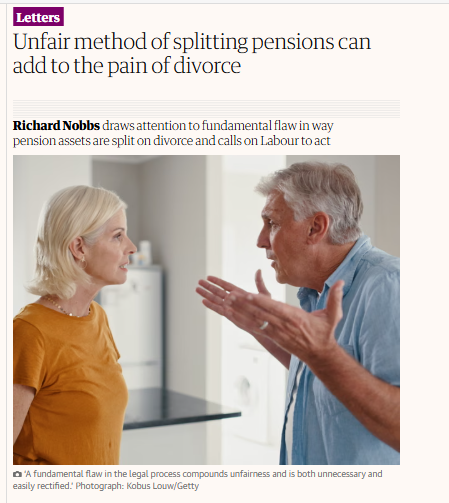
Excalibur’s submission to the Ministry of Justice was led by Richard Nobbs, Owner and Fellow of the Institute and Faculty of Actuaries, who has worked extensively in the area of pensions on divorce. Richard recently highlighted concerns around external pension sharing in a letter published in The Guardian.